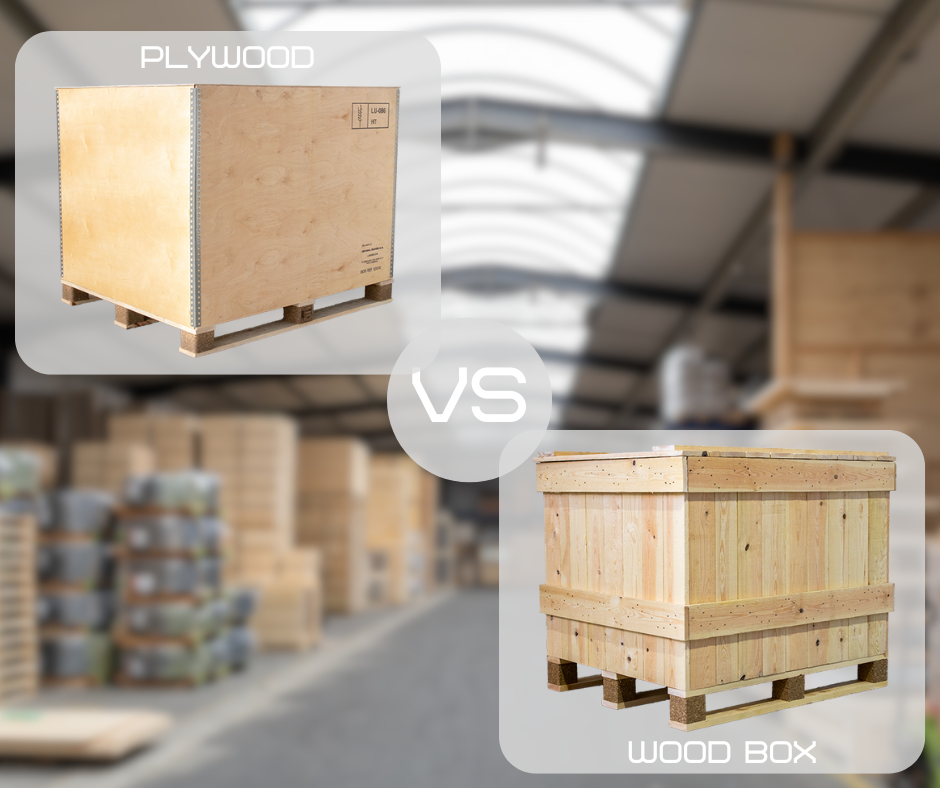
Foldable plywood box vs. solid wood box: which solution to choose?
In industrial packaging, the choice of material is strategic. Should you opt for a foldable plywood box or a traditional solid wood box? Each solution has its advantages and limitations. Here’s a full analysis to help you make the right decision.
Strength and Protection
Solid wood box:
Ideal for heavy and bulky loads. It offers exceptional mechanical strength, making it suitable for large industrial equipment.
Foldable plywood box:
Lighter yet robust. Plywood provides good shock resistance and is perfectly adapted to the needs of international transport.
Weight and Logistics
Solid wood box:
Heavier, which increases transport costs and may limit the number of boxes per container.
Foldable plywood box:
Up to 30% lighter than solid wood. Result: more boxes in the same container, saving space, time, and money.
Handling and Storage
Solid wood box:
Traditional assembly, bulky box, difficult to store when not in use.
Foldable plywood box:
Easy to assemble and disassemble. Once folded, it saves up to 85% of space in the warehouse or during return transport.
Environmental Impact
Solid wood box:
Made from thick boards, it requires more raw material. Its durability is an advantage, but the heavier weight results in a higher carbon footprint during transport.
Foldable plywood box:
Less material is used for equivalent performance. The lighter weight also reduces emissions linked to transport.
At No-Nail Boxes, our boxes are also PEFC-certified and produced as part of a CSR approach, ensuring sustainable resource management.
In Summary
Solid wood box: best for very heavy, bulky loads, or when extreme robustness is a top priority.
Foldable plywood box: ideal for export, large volumes, reducing logistics costs, and optimizing space.
👉 Both solutions coexist and meet specific needs.
But if your priority is logistical efficiency, cost reduction, and a controlled environmental impact, the foldable plywood box remains the strategic choice.